Tree Removal in Rochester, MN — Dead, Hazardous & Large Tree Removal
Dead oaks, split silver maples, and trees leaning over a roof. Every removal is priced on site, after somebody has actually looked at the drop zone.
Rochester Elite Treecare is your local resource for tree removal across Rochester, Olmsted County and Southeast Minnesota. We work with experienced arborists who can tell you which trees have to come down now, which ones can wait for the dormant season, and what it takes to get a big one on the ground without touching the house.
Most removals in Rochester come down to three trees. The oak that browned out from the top in July. The silver maple with two trunks that split at the union. The ash that has been thinning for three seasons and finally dropped a limb on the driveway. Each one gets taken apart differently, and the difference shows up in the price.
What drives the cost here usually is not trunk diameter. It is access. Rochester sits in the Zumbro River valley, and a lot of lots back onto wooded slopes and ravines where nothing on wheels gets within eighty feet of the tree. A twenty-four inch oak in an open backyard off Kutzky Park and the same tree on a bluff lot are two different jobs. That is why nobody quotes a removal over the phone.
Professional Tree Removal in Rochester, MN
Dead Tree Removal
A dead tree is a different job from a live one, and it gets more expensive the longer it stands. Once the cambium is gone the wood dries, the bark sloughs, and the limbs stop bending — they snap. That rules out climbing it and usually means the work happens from a lift or the tree comes down in one controlled drop if there is room. Rochester enforces this: after written notice on a hazardous or standing dead tree, an owner has 20 days to get it down, or the city has it removed at the owner's expense plus a $37.50 administrative fee, billed the same way as city taxes. Dead ash are the common version of this call, and they go brittle fast enough that a crew that quoted it in spring will re-look at it in fall.
Hazardous Tree Removal
Hazardous does not mean dead. It means the failure is already underway. Co-dominant stems with included bark, where two trunks grew tight against each other and never fused, are the classic Rochester version — silver maples planted forty years ago beside a garage, now sixty feet tall and splitting at the union. Other markers: a root plate lifting on one side, a crack you can slide a coin into, fungal brackets at the base, or a lean that changed after a storm. These get taken down in pieces with rigging rather than felled, because a tree that is already failing will not hinge predictably.
Large Tree Removal
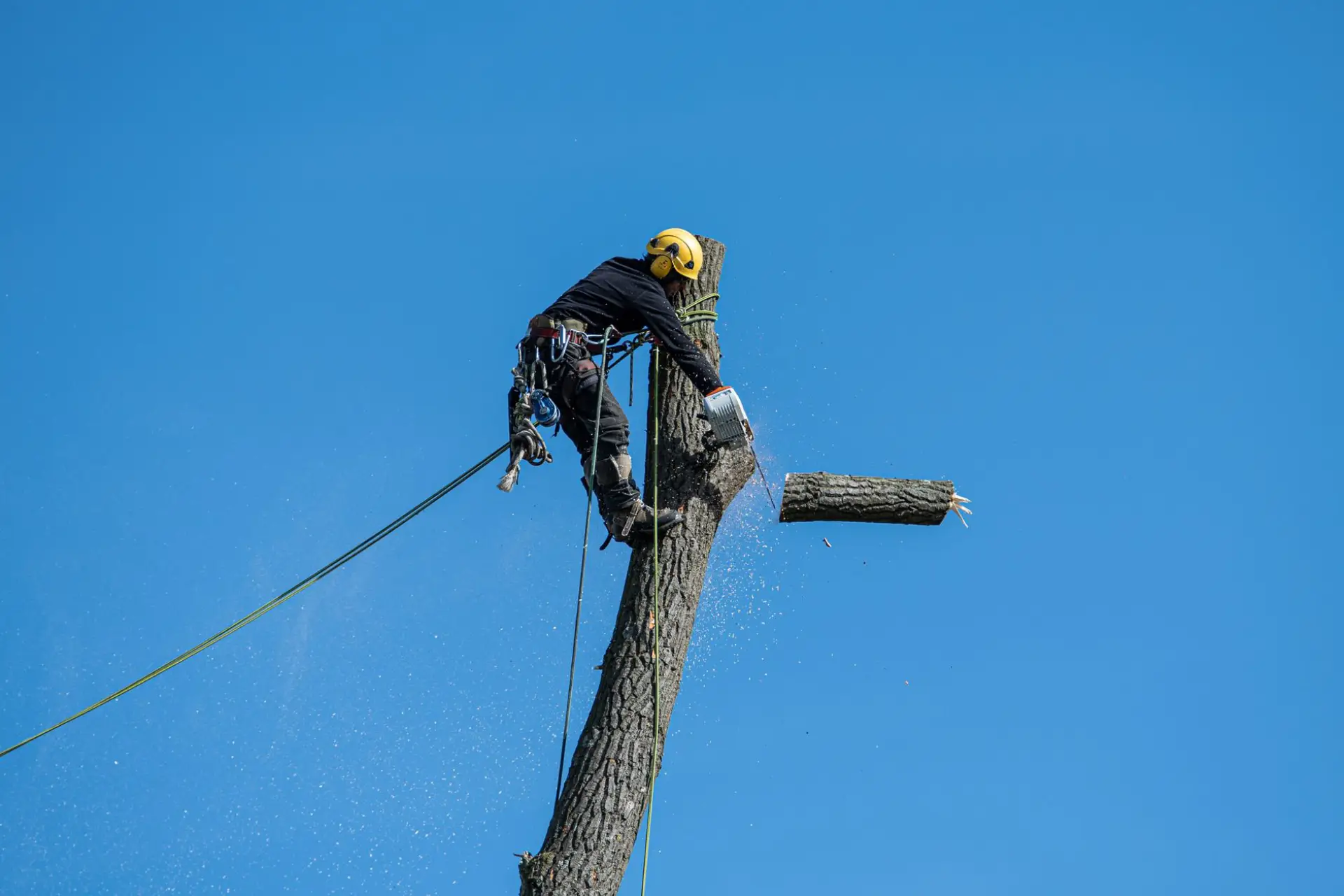
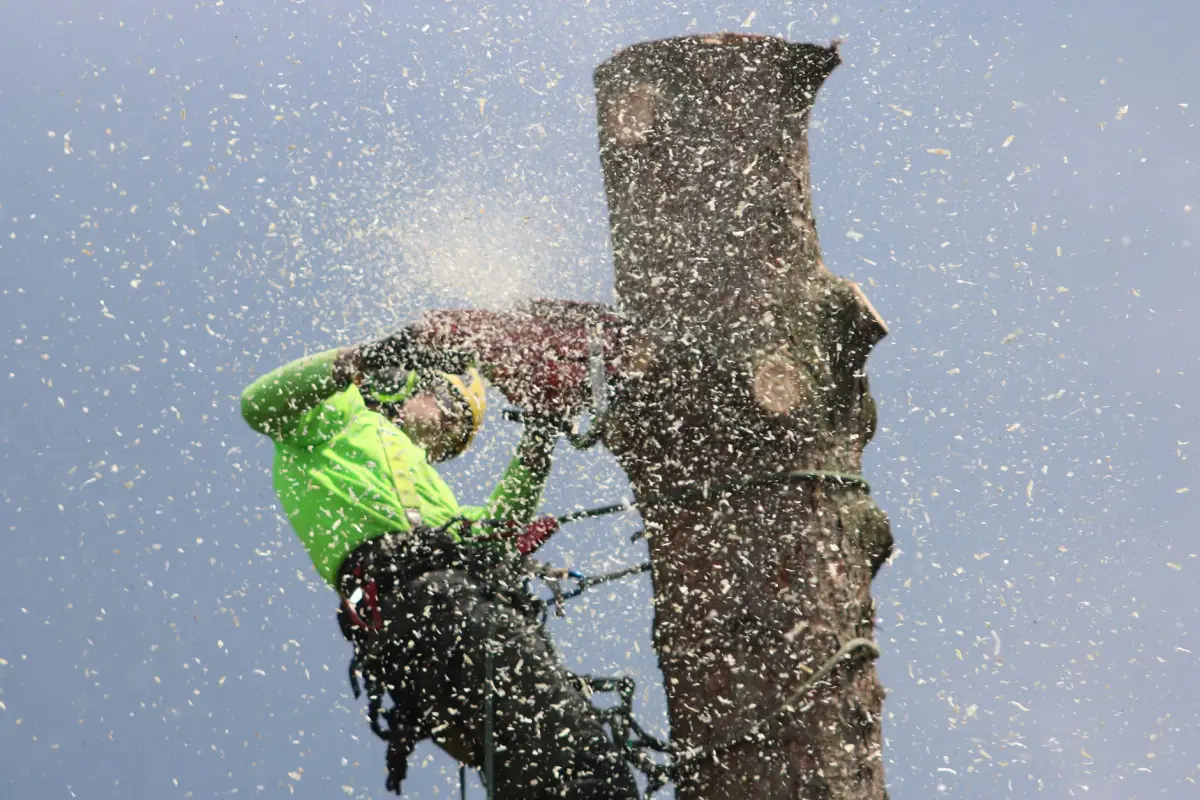
Past a certain size a tree stops being felled and starts being dismantled. A climber sets a line, takes the top out in sections, and lowers each piece on a rigging line or runs it out on a speedline to a clear landing area. Big oaks and cottonwoods on Rochester lots routinely need this, because there is no eighty-foot lane to drop them into. Where there is truck access, a crane makes it faster and often cheaper overall — picks come off the tree and go straight to the ground, so the crew spends hours instead of a day. Whether a crane fits down the driveway is the single biggest variable in what a large removal costs.
Tree Removal Near Homes & Structures
Removals tight to a house are priced on the drop zone, not the tree. If there is no room to let anything fall, every piece gets tied off, cut, and lowered under control — a slower process, more setup, more rope work. Roof lines, fences, a neighbour's garage, a deck, and overhead service lines all shrink the landing area. Worth knowing: if the limbs are into the primary power lines along the street, that is the utility's work and not something a homeowner pays for. Anything from the weatherhead to the house is the homeowner's side.
Residential Tree Removal & Cleanup
Cleanup is where quotes quietly differ, so it is worth pinning down before anybody starts. The usual scope is brush chipped and hauled, wood cut to length and stacked or taken away, and the drop zone raked out. Grindings from the stump are a separate decision — they can be left mounded, raked flat, or hauled off, and each costs differently. One Rochester-specific constraint: Olmsted County is under state and federal quarantine for emerald ash borer, so ash wood and hardwood firewood cannot simply be moved wherever, which affects where ash from your yard is allowed to go.
What's Included in a Rochester Tree Removal
- On-site assessment of the tree, the target zone, and access before anything is quoted
- Sectional dismantle with rigging where there is no safe drop zone
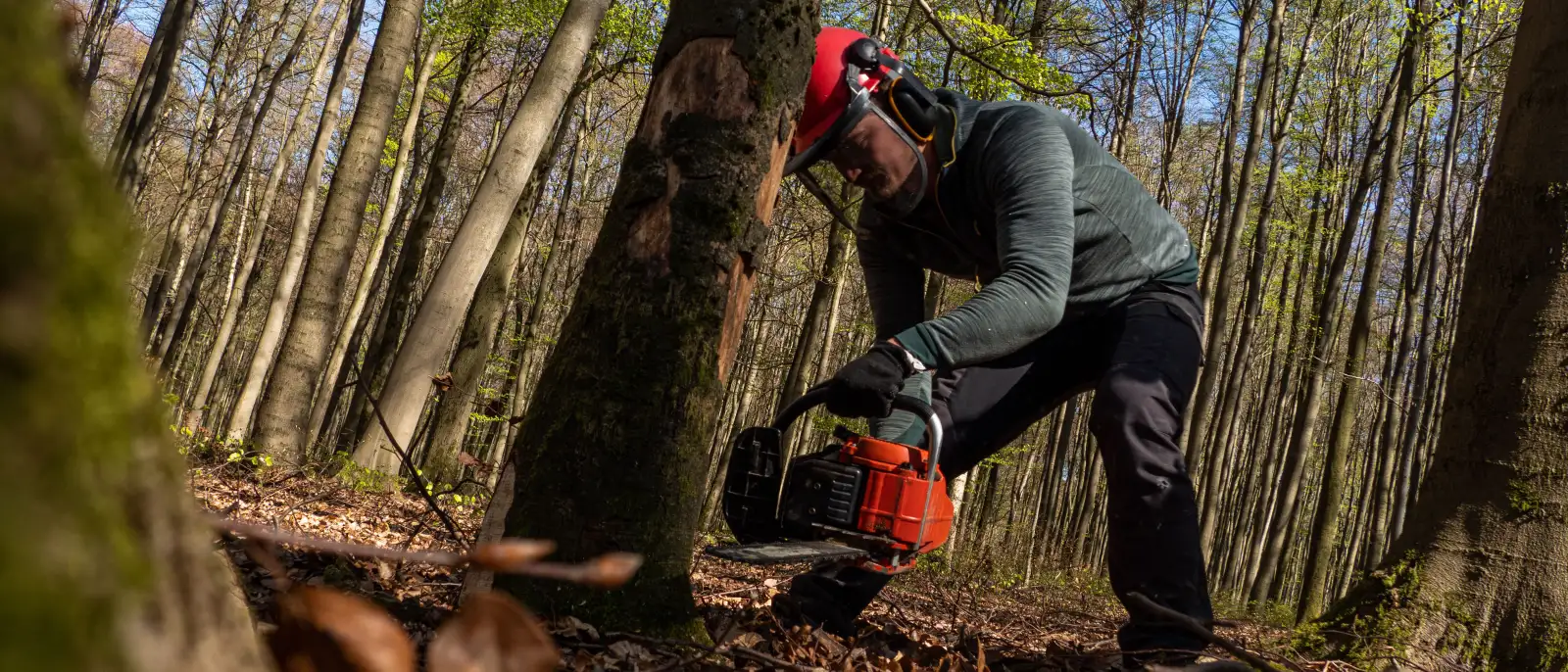
- Full felling where there is room, using a proper face cut and hinge wood
- Brush chipped and hauled off the property
- Trunk wood cut to manageable length, stacked on site or removed
- Drop zone raked and blown clean
- Stump ground on request — quoted separately, since the city does not require it
- Ash handled under Olmsted County's emerald ash borer quarantine rules
Signs a Tree Needs to Come Down
- The upper crown browned or thinned out over a single season while the lower branches stayed green — the classic oak wilt pattern
- Two trunks meeting in a tight V with bark pinched between them, on a tree big enough to hit something
- A crack in the trunk you can fit a coin into, or a seam that runs vertically for more than a few feet
- Soil heaving or lifting on one side of the base, which means the root plate is moving
- Shelf fungus or mushrooms growing out of the trunk or root flare — decay that is already well established
- Bark flaking off an ash in sheets, with S-shaped tunnels in the wood underneath
- A lean that is measurably different than it was before the last windstorm
How a Tree Removal Actually Goes
- 1
On-site assessment and quote
Somebody walks the tree before there is a number. That means checking the base and root flare for decay, fungal brackets and heaving soil, looking up the trunk for cracks, cavities and included bark at any union, and reading the crown for deadwood and the direction of lean. Then the harder half: what is under it and what can get to it. Driveway width, gate width, slope, septic and drain fields, sprinkler heads, fence lines, the neighbour's roof, and whether there are overhead lines in the way. On a bluff lot off the Zumbro, access alone can decide whether this is a half-day job or a two-day job. The quote comes out of that walk, in writing, with the cleanup scope spelled out — brush, wood, grindings — so there is nothing to argue about afterward.
- 2
Timing the cut, especially on oaks
Timing matters more in Southeast Minnesota than most places, because this is oak wilt country. Minnesota DNR guidance is not to prune or cut oaks from April through July: sap beetles are active, they are drawn to fresh cuts, and they carry the fungus from infected wood to healthy trees. Risk drops after mid-July, and winter is the safest window. So a healthy oak that is not threatening anything gets scheduled for the dormant season rather than cut in June. If a hazardous oak genuinely cannot wait — it is over the house, it is failing now — the cut gets made and the wound and the stump's outer sapwood get sealed immediately with wound paint or shellac, which is the DNR's own exception for hazard work. Ash gets scheduled around the quarantine on where the wood can go, not around beetles.
- 3
Setting up the drop zone and rigging
Before a saw runs, the landing area gets cleared and the property gets protected. Vehicles move, patio furniture moves, and plywood or mats go down over anything that will be driven across, because a wet Rochester spring lawn and a loaded chip truck do not mix. Then the crew decides how the tree comes apart. With a real drop zone, it is a face cut, a back cut, and correct hinge wood, and the tree goes where it was aimed. Without one, a climber sets a line in the spar and works top-down, cutting sections and lowering them on a rigging line, or running them out on a speedline to a clear spot. Spikes are used here because the tree is coming down; they never go on a tree that is staying.
- 4
Takedown, cleanup, and what's left behind
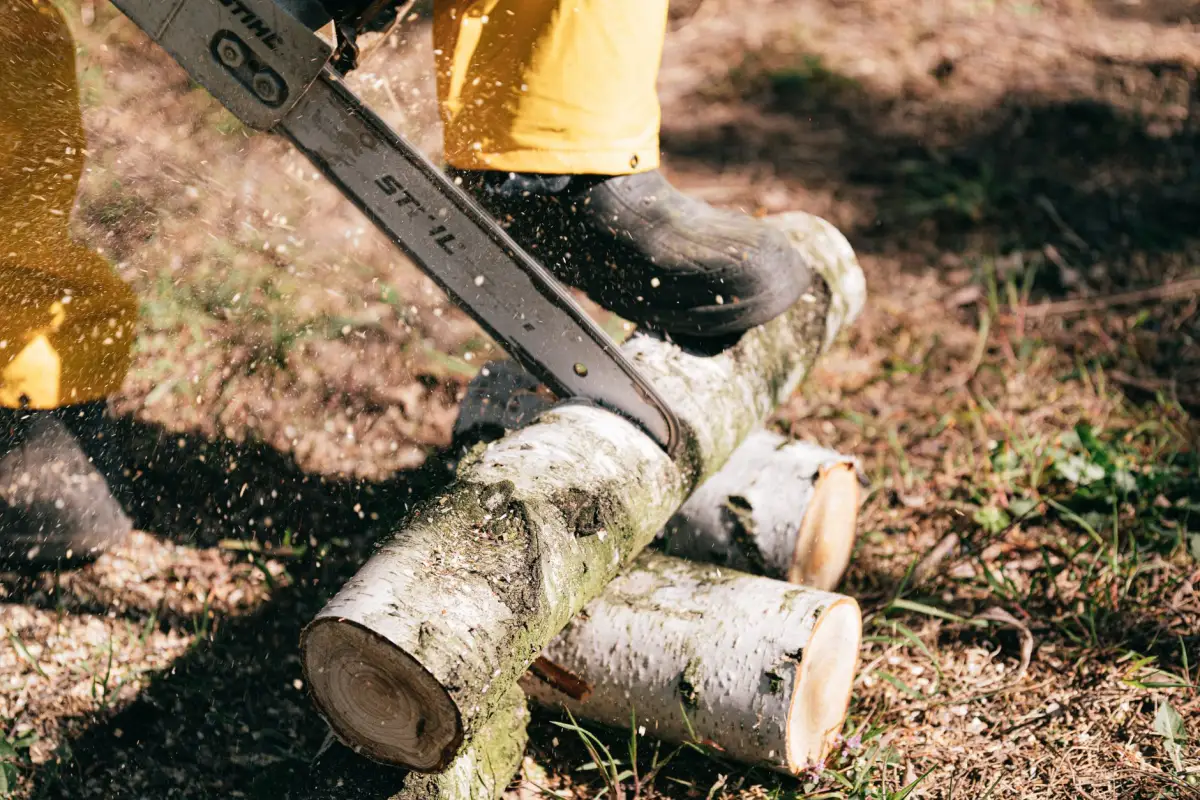
The tree comes apart from the top, brush goes to the chipper as it hits the ground rather than piling up, and the trunk is cut into rounds or lengths depending on whether the wood is staying. Then the stump decision: the city's hazard-tree ordinance does not require stump removal, so leaving it is legal and it is genuinely cheaper. Most people grind it anyway to mow over the spot. Grinding is quoted separately and the grindings can be left mounded, raked level, or hauled. The last pass is raking and blowing the drop zone, checking the roof and gutters for anything thrown up there, and walking the property so nothing gets found in the grass in July. Ash gets loaded and taken to a facility that can legally accept it under the county quarantine.
What Does Tree Removal Cost in Rochester, MN?
- Access above everything — whether a chip truck, a lift, or a crane can physically reach the tree, or whether every piece has to be carried out by hand
- Height and spread, which set how many rigging points and how many cuts the job takes
- What is underneath: an open lawn is one price, a tree over a roof, deck and fence line is another
- Condition of the wood — dead and brittle costs more than live, because it can't be safely climbed
- Species and wood weight; a cottonwood and an oak of the same diameter don't lower the same
- Whether the stump is ground, and what happens to the grindings
- Whether it's ash, which has to go to a facility that can legally take it under the county quarantine
- Season — dormant-season work on oaks is safer and easier to schedule than mid-summer emergency work
The number that moves a removal quote most is the one people expect least: how far the truck can get from the tree. Carrying every round of a sixty-foot oak up a ravine slope by hand is hours of labour that a chip truck twenty feet away would have absorbed in minutes. Ask for the quote in writing with the cleanup scope named — brush, wood, and grindings each handled separately — because that is where two quotes on the same tree usually turn out not to be the same job.
What to Look for in a Rochester Tree Removal Company
Quoted on site, not over the phone
Nobody can price a removal from a description. Access, drop zone and wood condition decide the number, and all three need eyes on them.
A straight answer on whether it has to come down
Plenty of trees that look alarming are structurally fine, and some that look fine are not. The useful version of this conversation includes the option of not removing it.
Oak work scheduled around the DNR window
Cutting a healthy oak in June to fit a calendar is how the oak next door gets infected. Non-urgent oak work belongs in the dormant season.
The cleanup scope written down
Brush, trunk wood and grindings are three separate decisions. A quote that names all three is comparable to another quote. One that says "cleanup included" is not.
Ash handled under the quarantine
Olmsted County is quarantined for emerald ash borer. Ash wood has to go somewhere that can legally take it, which is not the same as anywhere.
Residential and Commercial Tree Removal
Residential
Most residential removals in Rochester are one tree that has become a problem: a dead ash, a storm-cracked maple, an oak too close to the foundation. The work is priced per tree, off an on-site look, and scheduled around the DNR's oak pruning window when the tree is an oak and the situation allows it.
Commercial
Commercial removals run on different constraints — parking lot access, tenant traffic, and work windows outside business hours. Those jobs are covered on the commercial tree removal page, including multi-tree removals and work around buildings and lots.
When Removal Isn't the Right Call
- The tree is on the boulevard between the sidewalk and the street. That is a city tree, not yours. Boulevard work needs a permit from Rochester Forestry, and if the tree is genuinely hazardous the city removes it at no cost to you. Call Forestry at 507-328-2515 before paying anybody.
- The limbs are into the primary power lines running along the street. The utility clears those, and it does not cost you anything. Only the line from the pole to your house is on your side.
- It's a sapling under about four inches through with nothing underneath it. That is a pole saw and an afternoon, not a crew and a chip truck.
- The oak is healthy and nothing is threatening a structure, and it's June. The honest answer is to wait for the dormant season — cutting oaks between April and July is how oak wilt spreads.
- You already have a specific arborist you use. Call them directly. This site exists to help people who don't have one yet.
Frequently Asked Questions
- Do I need a permit to remove a tree in Rochester, MN?
- Not for a tree on your own property. Boulevard trees — the ones between the sidewalk and the street — are city trees and do need a boulevard tree work permit from Rochester Forestry. If a boulevard tree is structurally compromised and hazardous, the city removes it at no cost to you. If it is sound and you want it gone anyway, you pay for removal, stump grinding, and a canopy loss fee.
- What's the cheapest time of year for tree removal in Rochester?
- Winter, generally. Frozen ground carries equipment without rutting the lawn, there are no leaves to handle, and crews are less booked than they are after a summer storm. For oaks it is also the safe window — Minnesota DNR advises against cutting oaks April through July because sap beetles carry oak wilt to fresh cuts. The most expensive time is the week after a windstorm, when everyone calls at once.
- Why can't you give me a price over the phone?
- Because the tree is rarely what sets the price. Access is. A twenty-four inch oak in an open backyard with the truck at the curb and the same tree on a ravine lot where every round gets carried out by hand are two completely different jobs. Slope, gate width, what is under the tree, and whether the wood is live or brittle all move the number, and none of those come across in a phone description.
- Will my homeowners insurance pay for tree removal?
- Usually only when the tree has already fallen and hit something covered — a house, garage, fence, or car. A standing dead tree that has not damaged anything is typically maintenance, and maintenance is on the owner. Policies vary, so read yours. If a tree has come down on a structure, document it before anything is moved.
- Do I have to grind the stump?
- No. Rochester's hazard-tree ordinance covers the tree, not the stump — the city does not require stump removal. Leaving the stump is legal and cheaper. Most people grind anyway so they can mow over the spot, and because a stump left in place is a long-term home for decay fungi and, on oaks, a reason the root system stays connected to neighbouring trees.
- What happens to the wood and brush?
- Brush is normally chipped and hauled. Trunk wood is cut to length and either stacked for you or taken away. Ash is the exception: Olmsted County is under state and federal quarantine for emerald ash borer, so ash wood and hardwood firewood cannot be moved freely and have to go to a site that can legally accept them. If you want the wood for firewood, say so before the quote — it changes what gets loaded.
Learn More
- Minnesota DNR — Oak Wilt Management — the state's guidance on the April-through-July no-cut window and how oak wilt moves between trees
- City of Rochester — High Risk Trees & Standing Dead Trees — the 20-day removal notice, the administrative fee, and what the city does and doesn't require
- Minnesota Department of Agriculture — Emerald Ash Borer Quarantine — which counties are quarantined and what can legally be done with ash wood
Need Tree Removal in Rochester, MN?
Describe what’s going on and get an on-site estimate — no charge for the visit, and no obligation to book the work.
Get My Free Estimate