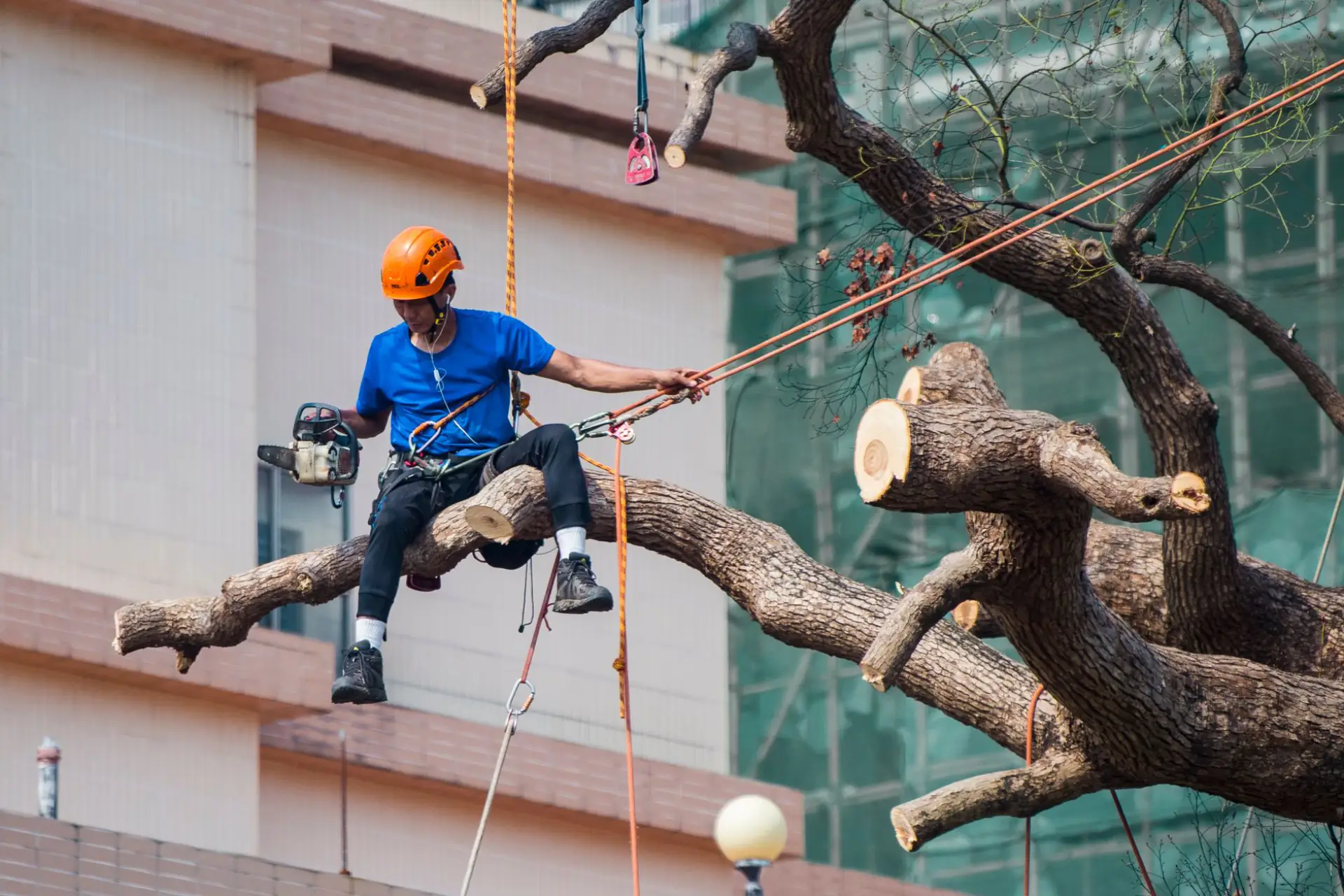
Tree Trimming in Rochester, MN — Pruning, Deadwooding & Crown Work
Pruning done to the ANSI A300 standard, on a schedule that respects Minnesota's oak wilt window. No topping, no flush cuts, no lion-tailing.
Rochester Elite Treecare is your local resource for tree trimming and pruning throughout Rochester, Olmsted County and Southeast Minnesota. We work with arborists who prune to the ANSI A300 standard and who will tell you when the right move is to leave a tree alone until winter.
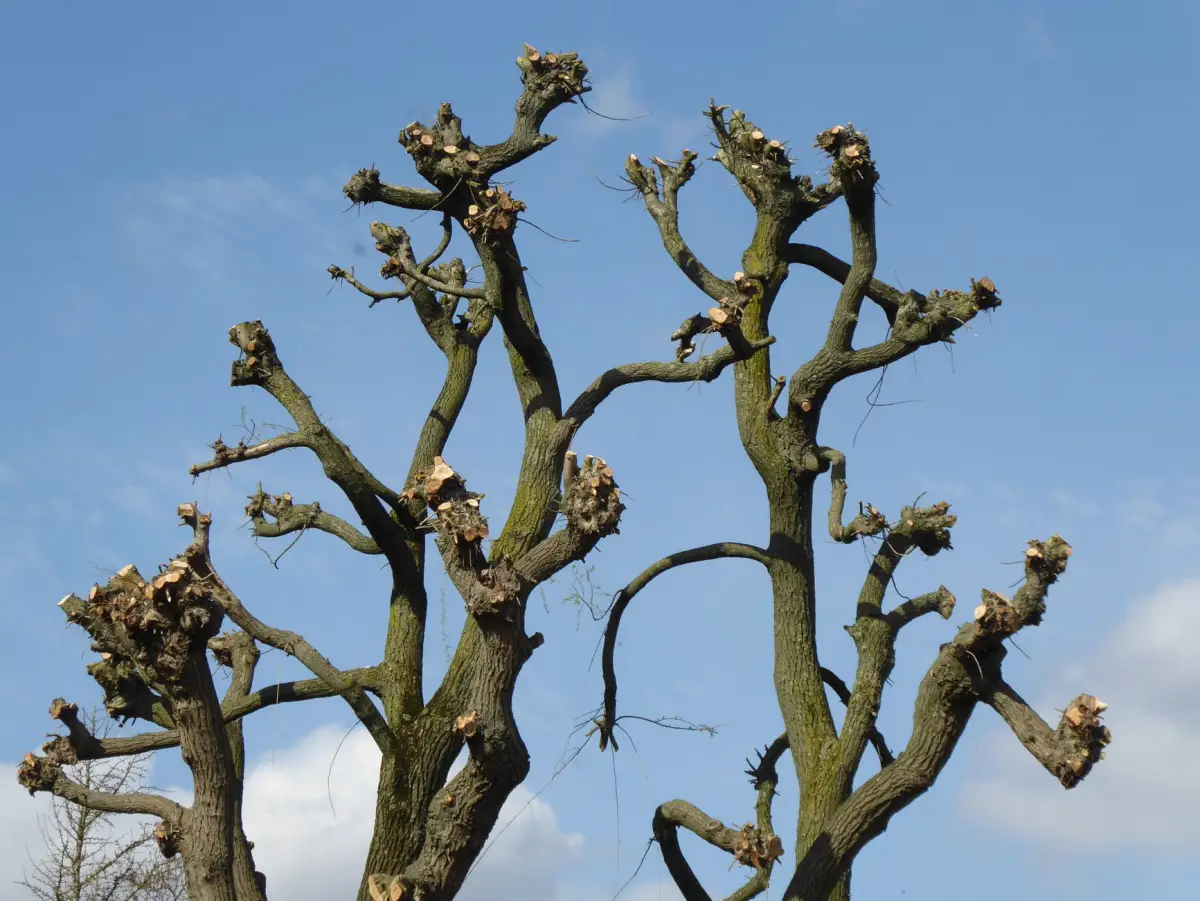
Good pruning removes less than people expect. The cut goes just outside the branch collar, the collar itself stays, and the tree seals the wound on its own. A flush cut takes the collar with it and leaves a wound the tree cannot close. Topping — cutting big limbs back to stubs — produces a flush of weak, fast-growing shoots attached to decaying stubs, which is worse structure than what was there before. Both are still sold in this market. Neither is pruning.
The other half of the job in Rochester is timing. This is oak country, and the Minnesota DNR is explicit: do not prune or cut oaks from April through July, because sap beetles are active then and they carry oak wilt to fresh cuts. Risk drops after mid-July and winter is safest. So an oak clearance job over a roof in Slatterly Park gets scheduled for the dormant season unless the limb is an actual hazard now. Maples, lindens and most other species have far more flexible timing.
Tree Trimming & Pruning in Rochester, MN
Routine Tree Trimming
Routine trimming is maintenance on a healthy tree: taking out deadwood, crossing and rubbing branches, water sprouts, and anything growing back toward the centre. Done on a cycle it is a small job every few years instead of a large one every fifteen. The rule of thumb worth knowing is that a mature, healthy tree should not lose more than about a quarter of its live crown in a single season, and less on an older or stressed tree — leaves are how it feeds itself. A quote that promises to take a third off a mature oak is describing damage, not maintenance.
Tree Pruning
Pruning is the structural version — deciding which branches the tree keeps for the next twenty years. On a young tree that means selecting a single dominant leader and removing competing stems before they become co-dominant trunks with included bark, which is the defect that splits silver maples in half in a windstorm. On a mature tree it means clean cuts just outside the branch collar so the tree can compartmentalize the wound. Every cut is a wound; the standard for how and where to make them is ANSI A300, and it is worth asking whether the person quoting works to it.
Dead & Diseased Branch Removal
Deadwooding takes out branches that have already died, which is both a safety job and a diagnostic one. Where the deadwood sits tells you something: scattered through the crown usually means age or shading, but a whole section dying at once points at a root or vascular problem worth looking into. Dead limbs over a driveway, a patio or a sidewalk are the ones that get priority, because dead wood does not bend — it snaps, and it snaps without warning on a still day. On oaks, dead-branch work follows the same April-through-July restriction as everything else.
Tree Crown Reduction & Thinning
These get confused constantly, and they solve different problems. Crown reduction shortens limbs back to a lateral branch big enough to take over as the new leader, which lowers the tree's height and sail area — the honest alternative to topping, and a real option for a tree that has outgrown its spot. Crown thinning removes selected interior branches to let wind and light through without changing the tree's shape. What thinning must never become is lion-tailing: stripping the interior and leaving all the weight on the branch ends, which makes limb failure more likely, not less.
Tree Clearance Around Homes & Structures
Clearance work is pruning aimed at a specific object: branches on the roof, limbs over the driveway, a canopy pushing into siding or blocking gutters, or a crown raise to get the lower branches above a walkway. Limbs resting on shingles wear them and hold moisture against the roof, so this is usually about the roof rather than the tree. One boundary worth knowing: branches into the primary power lines along the street are the utility's responsibility and are cleared at no cost to you. The service drop from the pole to your house is your side of the line.
What's Included in a Trimming Job
- A walk of the tree before pruning, to decide what actually needs to come off
- Cuts made just outside the branch collar — no flush cuts, no stub cuts
- Deadwood, crossing limbs and water sprouts removed
- Crown reduction back to appropriate laterals where height or spread is the problem
- Crown thinning without lion-tailing the branch ends
- Crown raise for clearance over walks, drives and roofs
- Brush chipped and hauled, work area raked and blown clean
- Oak work scheduled outside the April-through-July window unless it's a hazard
Signs a Tree Needs Pruning
- Branches resting on the roof or rubbing siding every time the wind blows
- Dead limbs visible in the crown, especially over a driveway, patio or walkway
- A young tree developing two competing leaders instead of one dominant trunk
- Interior branches crossing and rubbing each other bare
- A crown so dense that nothing grows underneath and wind loads the whole thing at once
- Limbs low enough over the walk or drive that you duck or the truck scrapes
- A previous topping job that has thrown up a thicket of weak upright shoots
How a Pruning Job Actually Goes
- 1
Deciding what the pruning is actually for
Every pruning job starts with a stated objective, because "trim it back" is not one. Clearance from a structure, deadwood removal, reducing end weight on an overextended limb, raising the crown over a driveway, and structural training on a young tree are five different jobs with five different sets of cuts. The walk-around covers species, age, general vigour, existing defects like included bark or old topping wounds, and the target — roofline, drive, walkway, neighbouring property. This is also where the honest answer sometimes turns out to be that the tree does not need pruning at all this year, which happens more often than people expect once someone has actually looked at it.
- 2
Timing it around oak wilt
In Southeast Minnesota, when the cut is made matters as much as where. Minnesota DNR guidance is not to prune or cut oaks from April through July: sap beetles are active in that window, they are attracted to fresh wounds, and they carry oak wilt spores from infected wood to healthy trees. The risk drops after mid-July, and winter is the safest time to prune oaks. Non-urgent oak work therefore gets booked into the dormant season rather than squeezed into a nice week in June. If a hazardous oak limb genuinely cannot wait, the DNR's own exception applies — make the cut and seal it immediately with wound paint or shellac. Most other species in this area have far more forgiving timing.
- 3
Access, climbing, and how the cuts get made
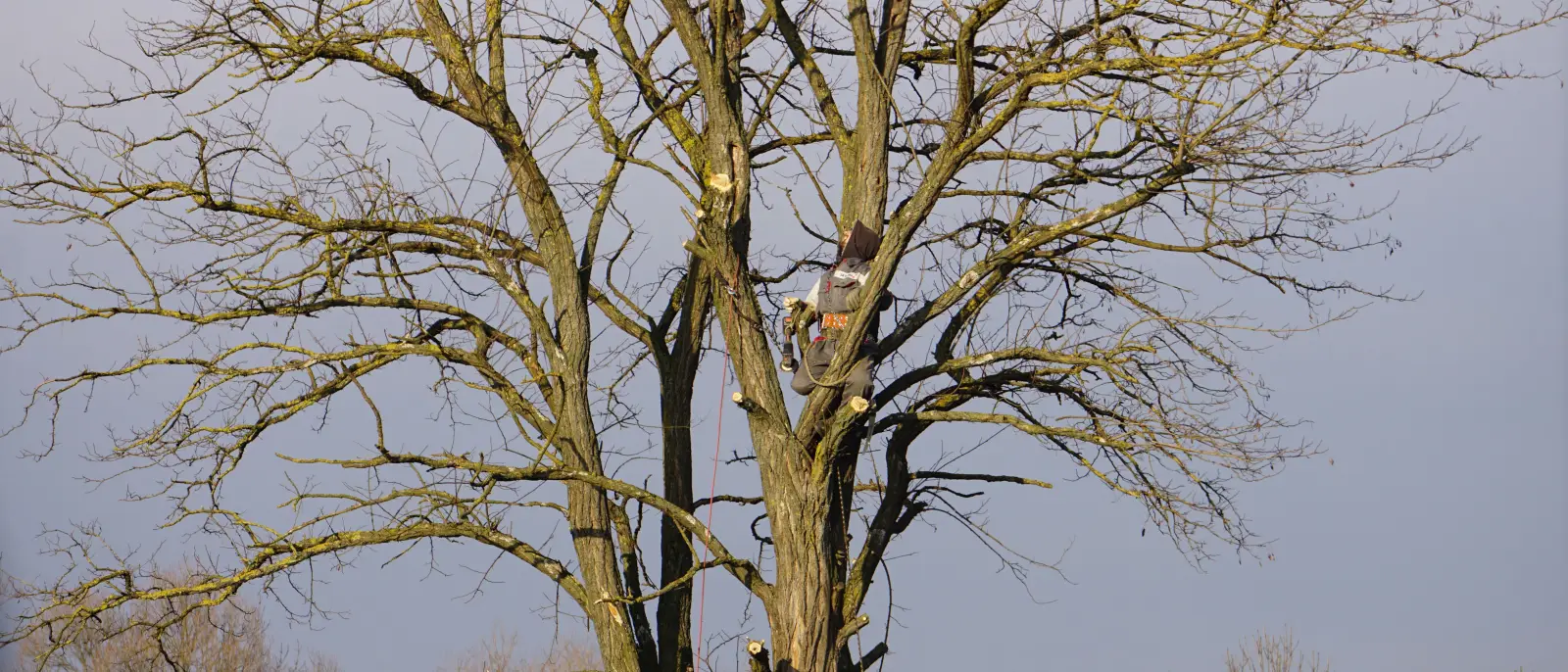
Access decides the method. Where a lift can reach the tree, work goes faster and the crew can hold position on the outer crown. Where it cannot — bluff lots, backyards behind a narrow gate, anything on the ravine slopes near the Zumbro — a climber sets a line and works the tree on rope. Spikes are not used on a tree that is staying; they punch holes in the cambium of a tree that has to live with them. Larger limbs get a three-cut sequence: an undercut, a relief cut to drop the weight, then a final clean cut just outside the branch collar so the collar is left intact and the tree can seal the wound itself.
- 4
Checking the balance, then cleanup
Before the ropes come down someone looks at the tree from a distance, because pruning that looked right from inside the canopy can turn out lopsided from the driveway. The check is whether the objective was actually met, whether the tree still reads as its own species, and whether too much live crown came off — the working limit on a healthy mature tree is roughly a quarter in one season, less on stressed or older trees. Then brush goes through the chipper, the work area gets raked and blown, and gutters get checked, since pruning over a roof puts material where nobody looks. What is left should look like a tree somebody pruned, not a tree somebody cut back.
What Does Tree Trimming Cost in Rochester, MN?
- Tree size and how much of the work is at height
- Whether a lift can reach it, or the whole job has to be climbed on rope
- The objective — deadwooding a maple is a different job from reducing an overextended oak limb
- How long since the last pruning; a tree neglected for fifteen years takes far more cuts
- Species and wood characteristics, which change how limbs are rigged and lowered
- What's underneath — pruning over a roof, deck or fence means rigging every piece down
- Season, and for oaks whether the work has to wait for the dormant window
- Number of trees, since crews already set up on site can price additional trees more keenly
Pruning is one of the few tree jobs where the cheapest quote is genuinely the most likely to cost you money. Topping is fast, which is why it is cheap, and it leaves a tree with decaying stubs and weakly attached regrowth that becomes a removal in ten years. The same is true of lion-tailing, which looks tidy from the ground and loads all the weight on the branch tips. Ask what standard the work follows and whether any live crown reduction goes past a quarter of the canopy.
What to Look for in a Rochester Tree Trimming Company
Pruned to a standard, not to a look
ANSI A300 exists so pruning is a repeatable practice rather than a matter of taste. Ask whether the person quoting works to it.
No topping, no flush cuts, no lion-tailing
All three are still sold in this market. All three make the tree weaker than it was and cost more to deal with later.
Oaks scheduled around the DNR window
Non-urgent oak pruning belongs in the dormant season. Pruning an oak in June is a fine way to give your neighbour's oak the same disease.
A limit on how much comes off
Roughly a quarter of the live crown in one season on a healthy mature tree, less on an old or stressed one. Leaves are how a tree feeds itself.
An objective before the first cut
Clearance, deadwood, reduction and structure are different jobs. Naming which one this is keeps the result predictable.
Residential and Commercial Tree Trimming
Residential
Residential trimming is usually clearance and deadwood — limbs off the roof, dead branches over the patio, a crown raise so the drive is usable. Priced per tree after an on-site look, and scheduled around the oak wilt window when oaks are involved.
Commercial
Commercial trimming runs on clearance standards and traffic instead: sightlines in a parking lot, branch height over drive aisles and walkways, and work scheduled outside business hours. That work is covered on the commercial tree trimming page.
When Pruning Isn't the Right Call
- You want the tree topped. Nobody working to a real standard will do it, and the regrowth is weaker than what you started with. If the tree is genuinely too big for the spot, the honest options are crown reduction to appropriate laterals or removal.
- It's a healthy oak, it's May, and nothing is threatening a structure. Wait for the dormant season. Cutting oaks April through July is how oak wilt gets into a neighbourhood.
- The branches you're worried about are in the primary power lines along the street. The utility handles those at no cost to you.
- It's a small ornamental you can reach from the ground with hand pruners. That's a Saturday, not a crew.
- The tree already has significant decay at the base or a split union. Pruning won't fix structural failure — that conversation is about removal or, in some cases, support hardware.
Frequently Asked Questions
- When should trees be trimmed in Rochester, MN?
- For oaks, the dormant season. Minnesota DNR guidance is not to prune or cut oaks from April through July, because sap beetles active in that window carry oak wilt to fresh cuts; risk drops after mid-July and winter is safest. Most other species can be pruned across a much wider range, though late winter is still generally the easiest time to see structure and the least stressful for the tree.
- What's the difference between crown thinning and crown reduction?
- Thinning removes selected interior branches to let light and wind through without changing the tree's overall size or shape. Reduction shortens limbs back to a lateral branch large enough to take over, which lowers the tree's actual height and spread. If the problem is a dense crown, you want thinning. If the problem is that the tree is too big for where it stands, you want reduction — not topping.
- Why is topping bad if it makes the tree smaller?
- Because it does not stay smaller. Cutting limbs back to stubs removes the branch collar, so the tree cannot seal the wound and the stub decays. The tree responds by throwing dense upright shoots that grow fast and attach weakly to that decaying wood. Within a decade you have a taller tree with worse structure and a decay column running down the trunk. Crown reduction back to appropriate laterals achieves the size change without any of that.
- How much can be safely removed from a tree at once?
- On a healthy mature tree, roughly a quarter of the live crown in a single season is the working ceiling, and less than that on an older or already-stressed tree. Leaves are how a tree produces food, so heavy removal starves it and triggers stress growth. If a tree needs more taken off than that, the work gets split across seasons — or the honest answer is that it is in the wrong place.
- Do you need to paint pruning cuts?
- Generally no. A correct cut just outside the branch collar seals itself, and wound paint does not speed that up. The one real exception in this region is exactly the situation the DNR flags: if an oak has to be cut during the April-through-July high-risk period because it is hazardous, the cut and any stump's outer sapwood should be sealed immediately with wound paint or shellac to keep sap beetles off the fresh wound.
- How often do trees need pruning?
- Young trees benefit from a look every two to three years while structure is still being set, which is when it costs almost nothing to fix a competing leader. Mature trees are usually on a longer cycle — every three to five years for deadwood and clearance, longer if nothing is growing into a structure. A tree that has not been touched in fifteen years is not on a cycle; it is a project.
Learn More
- Minnesota DNR — Oak Wilt Management — why oaks should not be pruned April through July, and what to do if a hazard cut can't wait
- University of Minnesota Extension — Oak Wilt in Minnesota — how the disease spreads above ground through beetles and below ground through root grafts
- Minnesota DNR — Tree Care — state guidance on pruning, planting and maintaining trees in Minnesota
Need Tree Trimming in Rochester, MN?
Describe what’s going on and get an on-site estimate — no charge for the visit, and no obligation to book the work.
Get My Free Estimate